Posts

Er worden posts getoond met het label Germany

Castellum Zugmantel

Afbeelding
In the woods near Ortlen in Germany, you can find the remains of a small wooden castle, now called (Castellum) 'Kastell Zugmantel'. It was erected in the years 83 to 86 AD and later enlarged with a garrison of 200 men from Numerus Treverorum. The final expansion of troops came during the reign of Emporer Caracalla (211-217 AD). The fortification was the garrisoned by Cohors II Treverorum. It was the smallest fortification of a Cohors equitata at the Upper German Limes. It was finally abandoned around 260 AD, when the Allemanni tribes overrun the territority. Between the castellum and the Limes are the remains of two small amphitheaters, belonging to the vicus. This vicus is very well examined. A similar site was found at Castellum Dambach in Wales at Tomen-y-Mur and near Kastell Arnsburg in Germany.  It is quite odd to post images of the current forest, but without clear references to the two amphithe...

Next stop: Mainz Romisches Theater

Afbeelding
Last week, I visited Mainz or Mogontiacum in Germany. We took the train from Mainz Hbf to Wiesbaden and got out at railway station 'Mainz Romisches Theater'. It is incredible to learn that the train is almost running throught the scanea frons. Ever since 1884, when this railway line was built, it has been known that remains of Roman buildings were at this site. But exactly what it was, and how big, was unclear. Only in 1914, when railway works were carried out, it was recognized that the remains belonged to the theater of Mogontiacum. It was the first time, since the 11th century, when the historian Gozwin wrote: "Hoc etiam astruunt adhuc superstites theatri ruinae, quod Romano more ad ludos circenses et theatrica spectacula constructum est", that the building was recordably identified as the theater in modern times. During the First World War however, it was covered by soil and forgotten again. It was rediscovered in 1998 and subject to systematic excavation.  The...

Mask at the Saalburg

Afbeelding
The defence-line on the frontier of the Roman province of Raetia, extending from Lorch to the Danube. It consisted in its later form, of a stone wall with built-in-watch-towers, and forts behind. It had no palisade. The first Roman defences at the Saalburg were erected during the course of a war waged by Domitianus against the Chatti, a Germanic tribe in the north of Hessen, in 83-85 AD.  During the reign of Hadrian (117-138) a large fort was built, defended by a composite wall of timer and stone. It held the cohors II Raetorum civium Romanorum, consisting of about 500 men. Currently, the Roman fort at the Saalburg is a beautiful copy of the old Roman site, erected between 1898 and 1907 by Kaiser Wilhelm II. The reconstruction possesses e.g. walls, gates, ditches, bridge, horreum, roads, praetorium, thermen and a very nice museum. This wonderful mask was found in the courtyard or peristyle of a house belonging to the vicus of Saalburg near Mainz (Germany). It is made out of y...

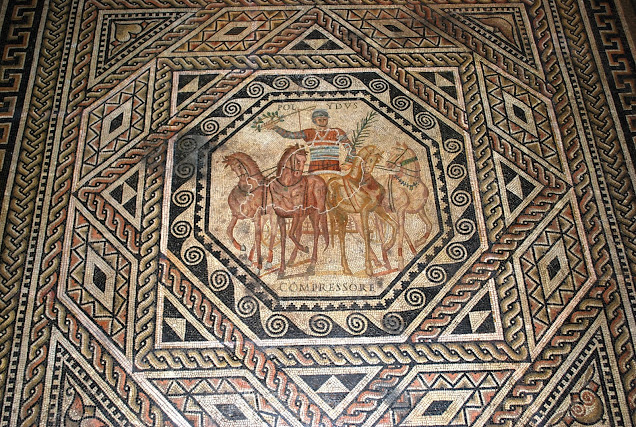
Polydus, champion charioteer for the reds

Afbeelding
Last week, I visited Landesmuseum Trier for the third time, which probably sounds boring but its collection is of great quality. The museum was renovated a few years ago, so a good excuse to visit it again. In my previous blog post I already wrote that the circus of Colonia Augusta Treverorum dates back to the earliest period of the cities history. The race track may have been created immediately after the city was founded. Quite some interesting finds, referring to the circus are in Landesmuseum Trier on display, including this mosaic of Polydus, a popular charioteer for the red faction (factio russata), and his lead horse Compressor. He is taking a victory lap. My picture is the centerpiece of a mosaic floor from a villa in front of the Imperial Baths in Trier. The representations on Roman mosaics of the victorious charioteer of the circus may be compared with similar representations in other forms of Roman art, both major and minor. Certa...

Fountains on the spina in Trier

Afbeelding
The circus appears to date back to the earliest period of the history of Trier or Colonia Augusta Treverorum ; the race track may have been created immediately after the city was founded. However, the hippodrome, which was about 450 meter long, became truly monumental in the first half of the second century. It was renovated after 293, when Constantius Chlorus moved his residence to Trier. We know that the monument was connected to the aqueduct, and we may assume that there were fountains on the spina . On this photograph, taken of a model in Landesmuseum Trier last week, you can see that the circus is at the outskirts of city. You can't see that is quite near the amphitheater, which was integrated in the city wall.  The circus vanished completely. Currently the whole area is covered with houses. Heinz Cuppers, writes in 'Die Romer in Rheinland-Pfalz', that the circus was one of  the first buildings to be destroyed by the new inhabita...

Map Colonia Augusta Treverorum

Afbeelding
The amphitheater of Colonia Augusta Treverorum or Trier, was part of the city wall. It was built into the slope of the Petrisberger Mountain. Of the roughly 125 known Roman amphitheaters, the one in Trier is the tenth largest and seated between 18,000 and 20,000 spectators. The Rheinischen Landesmuseum Trier has two models of the Roman city on display, of which I both have taken pictures. Some of my pictures of Colonia Augusta Treverorum you can find here ! 

Altar for the gladiators' Genius

Afbeelding
This small, elegant altar is on display in Landesmuseum Trier or Colonia Augusta Treverorum . It is very special because it is erected in honor of the Genius of the gladiators in the city. It says: In h(onorem) d(omus) d(ivinae) / genio arena / riorum con / sistentium / Col(onia) Aug(usta) Tre(verorum) / Axsillius Av / itus sive Sa / cruna / d(onum) d(dedit). Or: To honor the divine house of the Emperor has Axsillius Avitus, also called "Sacruna", erected this altar for the Genius of the gladiators of Augusta Treverorum. Second half, third century AD. Limestone.

Castra Vetera

Afbeelding
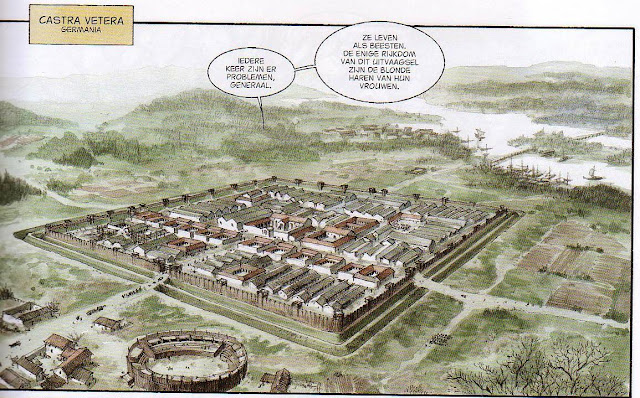
Last month the third volume of the comic of 'Les Aigles de Rome' or 'Eagles of Rome' by Enrico Marini was published in the Netherlands. Also this volume is great! It's about the Cheruscian Arminius and his Roman 'brother' Marcus Valerius Falco, both raised in the same Roman family and both suffering the same harsh Roman education. Arminius and Marcus meet after years of separation in Germania during the days of Varus, but times have changed. I really like the great drawings, the story is rough and full of violence and sex. For someone raised with the Smurfs, a revelation! Watch the trailer about the making of the series. Around 15 BC the Roman camp Castra Vetera was created on the Fürstenberg near today's locality Birten in Germany. It was intended as a base for campaigns into Germania and until its destruction during the Revolt of the Hatavi in 70 AD, by Arminius, it was occupied by 8,000 to 10,000 legionaries, and the main base of the Classis germanic...

Colonia Ulpia Traiana

Afbeelding
Last Saturday, I visited the archeological park at Xanten or Colonia Ulpia Traiana. It covers large parts of the original settlement and various buildings have been reconstructed. The original city almost completely vanished, while it was used as a query for building the modern city. The amphitheater is an almost exact copy of the ancient building. More pictures can be found here ! Around 15 BC the Roman camp Castra Vetera was created on the Fürstenberg near today's locality Birten. It was intended as a base for campaigns into Germania and until its destruction during the Revolt of the Batavi in 70 AD it was occupied by 8,000 to 10,000 legionaries, and was the main base of the Classis germanica. After the destruction of Castra Vetera a second camp became established at the Bislicher Insel, named Castra Vetera II, which became the base camp of Legio VI Victrix . A nearby created settlement, which was inhabited by 10,000 to 15,000 usually former legionaries, was given the ri...

Green, red, blue or white?

Afbeelding
This stunning Roman oillamp shows a racing chariot with two horses, or a biga. It is beautiful, primarily due to its almost childish simplicity. In my opinion it is one of the best objects of the Römisch Germanisches Museum in Köln. At the end of the first century AD, Rome had four racing stables. Each with a substantial amount of supporters, called factiones. These factiones were called 'the Green' (factio prasina), 'the Blue' (factio veneta), 'the Red'(factio russata) and 'the White' (factio albata). These four racing stables were of sociatal importance and had political significance. Even the Emporer had its favourite stable. This oillamp, found in Köln shows the popularity of chariot racing in the Roman world, while in Germania, only Trier had a hippodrome of significant size: 440 by 86 meters. More of my pictures of oil lamps you can find here !

MIRANDVS, my favorite horse!

Afbeelding
This playpiece, at display in Cologne, was used in a game as 'racehorse'. Can you imagine a Roman, concentrating on etching the name of his favorite horse, 'MIRANDVS' or 'To be admired', in this stone? Fascinating! I don't know how the game was called nor its rules - probably 'Latrunculi' -, but I will soon find out. More of my pictures at C(laudia) C(olonia) A(ra) A(ggripensium) or Cologne, can be found here .

Gladiator helmetshaped oillamps

Afbeelding
In the Römisch Germanisches Museum in Köln or C(olonia) C(laudia) A(ra) A(grippinensium), I found these two very fine clay oillamps, both in the shape of a gladiator helmet. The left one has the shape of a helmet of a so-called thraex, or Thracian. Originally, gladiators were named after civilizations which ones fought the Romans. This gladiator was armed in Thracian style with a small rectangular shield and a very short sword with a sligthly curved blade called a sica. The right oillamp is in the shape of the helmet of a hoplomachus, armed to resemble a Greek hoplite. A soldier with heavy armor and helmet, round shield, spear and a small sword. Among many other beautiful objects, those really caught my attention, because CCAA had both a theater and an amphitheater, of which no remains have been found yet.

Theater objects at CCAA

Afbeelding
Last week I visited Köln (Cologne) or Colonia Claudia Ara Agrippinensium (CCAA), and was impressed by the great amount of objects relating to theater and amphitheater, although no remains of such buildings have been discovered in the city yet. This great mask was discovered in 1899, at the Alteburg at Köln. It is 27 x 21 cm, of clay and dates of the 3rd century AD.  More pictures of CCAA can be seen here ! In earlier entries I already added pictures of other masks, found at Tarraco and Noviomagus. Of lesser quality, but for actual use and so just as interestering: press (Tarraco) or click (Noviomagus)! This mask is large enough that an actor could have hidden his face behind it. Its weight, however, makes it unlikely that it was worn during a play. It was more likely hung up as decoration with the help of a ribbon drawn through two holes near the ears. It is strongly modeled. Besides the characteristic big wart above the beaked nose, the circular openings for the eyes and the t...