Posts

Er worden posts getoond met het label amphitheater

A gladiator north of the limes

Afbeelding
Today I visited the regional museum 'Huis van Hilde' in Castricum, a small town north of the city of Velsen or Roman 'Flevum' in The Netherlands. It was one of the large military settlements or castra, the Romans built along the northern border of their Empire, the Rhine River, to defend themselves against invaders and to prepare for conquests with several legions, in this case fleet expeditions to the Wadden Sea, Ems and Elbe and the invasion of England. There was a harbour where several warships could dock. Unlike most smaller forts, this army camp was built north of the river.  Both Ptolemy, who refers to "Phleum," and Tacitus mention this fortress, but its exact location has long remained a subject of speculation. In the 1980s however, a small Roman castellum was excavated near Velsen, which, according to coin finds and radiocarbon dating, must have been destroyed in the year 28. It is assumed that this was the castellum Flevum.  The fortress played an imp...

Amphitheater of Lutetia Parisiorum

Afbeelding
This spring I visited the amphitheater of Lutetia in Paris. It is a very special place in a predominantly busy city. When I visited, parents were playing with their children, football was being played and there was rest.  What we see today is a Gallo-Roman mixed-used amphitheater with a stage. It consisted of an oval arena, two large lateral entryways and a cavea that did not completely encircle the arena. The missing section was taken up by a stage for mimes, pantomimes and singing performances. The arena was where gladiatorial combats (munera) took place and where wild beasts were hunted (venationes). The structure had an exterior gallery and a highly ornamented facade. It has an impressive size, 100 by 130,3 meters and it is one of the largest constructions of its kind in Gaul. Its total capacity is estimated at 17,000 spectators, so almost all inhabitants of the city that time could find a place there. It consisted of an oval arena, two large lateral entrywa...

Boxing gloves from Vindolanda

Afbeelding
Bij de Muur van Hadrianus in Engeland zijn twee leren bokshandschoenen van de Romeinen gevonden uit ongeveer 120 na Christus. Dat meldt The Guardian . Het zijn waarschijnlijk de enige exemplaren die de eeuwen hebben overleefd. De twee handschoenen, die op het oog geen paar vormen, zijn gevonden in een Romeinse legerplaats, die vorig jaar werd gevonden onder een stenen fort uit de vierde eeuw. Dat was het fort van Vindolanda ten zuiden van de muur van Hadrianus bij Hexham.  Boksen was een populaire sport bij de Romeinen, gezien de talloze verwijzingen ernaar in teksten en afbeeldingen uit die tijd. De leren bokshandschoenen waren eigenlijk een soort banden die om de knokkels van de hand zaten en die waren gevuld met natuurlijke materialen om schokken te absorberen. De handschoenen zijn niet vervormd en passen nog steeds om een normale hand. In één van de handschoenen zijn zelfs de afdrukken van de knokkels te zien. De grootste van de twee is ooit gerepareerd. In de opgegrav...

Gladiators and charioteers in Noviomagus

Afbeelding
This morning I visited museum Het Valkhof in Nijmegen, at Oppidum Batavorum or Ulpia Noviomagus Batavorum . Het Valkhof is a remarkable museum with an extraordinary fine collection of Roman finds, both from the vicus and the military settlements. Among these finds are two beautiful objects, a green glazed bowl and a terra sigillata jar. One shows fighting gladiators and the other one a racing chariot. This well preserved bowl shows fighting gladiators in an amphitheater. A heavy armoured gladiator attacks his opponent, armed with trident and dagger. At the opposite side you can see a referee, carrying a stick, intervening. The bowl was made in Cologne (Colonia Claudia Ara Agrippinensium) and capital city of Germania Inferior, probably at the end of the 2nd century AD. It was found at the cemetry of Noviomagus. The second object is this terra sigillata jar, decorated by three medailions. One with a deer, one with a dog, and the one shown here, with a quadriga. The driver show...

Pompéi. Les Nouvelles Fouilles et l'Amphithéâtre

Afbeelding
On June 4, I celebrated my 52th anniversary and received a very special gift from my friend Marty. An old travel guide: "Pompei: Les Nouvelles Fouilles (Maisons et Habitants) et l'Amphithéâtre. Ouvrage illustré de 47 Figures". This small treasure dates from 1944 and once belonged to the 'Direction des Antiquites de l'Algerie'. A special section is dedicated to the amphitheater. Herewith, I quote a part of the paragraph 'L'Amphithéâtre', of this lovely booklet: "L'Amphithéâtre de Pompéi ne se trouve ni parmi les plus grands, ni parmi les plus remarquables des édifices de ce genre, main c'est le plus antique. Il a été construit en effect peu après l'an 80 avant J.C. par deux riches magistrats Caius Quintius Valgus et Marcus Porcius à la suite de leur victoire aux élections. Ils supportèrent tous les frais de sa construction et en firent don à la Cité pour y présenter des spectacles de gladiateurs. Il était accessible par le...

Castellum Zugmantel

Afbeelding
In the woods near Ortlen in Germany, you can find the remains of a small wooden castle, now called (Castellum) 'Kastell Zugmantel'. It was erected in the years 83 to 86 AD and later enlarged with a garrison of 200 men from Numerus Treverorum. The final expansion of troops came during the reign of Emporer Caracalla (211-217 AD). The fortification was the garrisoned by Cohors II Treverorum. It was the smallest fortification of a Cohors equitata at the Upper German Limes. It was finally abandoned around 260 AD, when the Allemanni tribes overrun the territority. Between the castellum and the Limes are the remains of two small amphitheaters, belonging to the vicus. This vicus is very well examined. A similar site was found at Castellum Dambach in Wales at Tomen-y-Mur and near Kastell Arnsburg in Germany.  It is quite odd to post images of the current forest, but without clear references to the two amphithe...

Map Colonia Augusta Treverorum

Afbeelding
The amphitheater of Colonia Augusta Treverorum or Trier, was part of the city wall. It was built into the slope of the Petrisberger Mountain. Of the roughly 125 known Roman amphitheaters, the one in Trier is the tenth largest and seated between 18,000 and 20,000 spectators. The Rheinischen Landesmuseum Trier has two models of the Roman city on display, of which I both have taken pictures. Some of my pictures of Colonia Augusta Treverorum you can find here ! 

Altar for the gladiators' Genius

Afbeelding
This small, elegant altar is on display in Landesmuseum Trier or Colonia Augusta Treverorum . It is very special because it is erected in honor of the Genius of the gladiators in the city. It says: In h(onorem) d(omus) d(ivinae) / genio arena / riorum con / sistentium / Col(onia) Aug(usta) Tre(verorum) / Axsillius Av / itus sive Sa / cruna / d(onum) d(dedit). Or: To honor the divine house of the Emperor has Axsillius Avitus, also called "Sacruna", erected this altar for the Genius of the gladiators of Augusta Treverorum. Second half, third century AD. Limestone.

Castra Vetera

Afbeelding
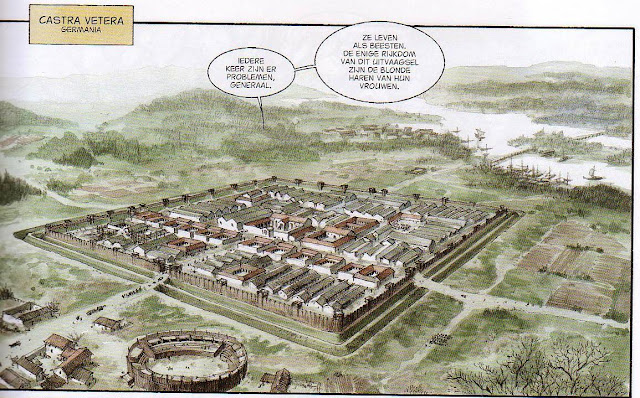
Last month the third volume of the comic of 'Les Aigles de Rome' or 'Eagles of Rome' by Enrico Marini was published in the Netherlands. Also this volume is great! It's about the Cheruscian Arminius and his Roman 'brother' Marcus Valerius Falco, both raised in the same Roman family and both suffering the same harsh Roman education. Arminius and Marcus meet after years of separation in Germania during the days of Varus, but times have changed. I really like the great drawings, the story is rough and full of violence and sex. For someone raised with the Smurfs, a revelation! Watch the trailer about the making of the series. Around 15 BC the Roman camp Castra Vetera was created on the Fürstenberg near today's locality Birten in Germany. It was intended as a base for campaigns into Germania and until its destruction during the Revolt of the Hatavi in 70 AD, by Arminius, it was occupied by 8,000 to 10,000 legionaries, and the main base of the Classis germanic...

Amphitheater of Casinum

Afbeelding
The amphitheater of Casinum, erected by Ummidia Quadratilla (whose passion for actors is mentioned by Pliny, Epist. vii.24, on the occasion of her death, and quoted in my post about the theater of Casinum, still exists. She was a wealthy Roman aristocrate and a member of the gens Ummidia. She died in the reign of Emperor Trajan (98-117) within a little of eighty years of age, leaving two-thirds (ex besse) of her fortune to her grandson and the other third to her granddaughter. Her grandson Ummidius Quadratus was an intimate friend of Roman Senator and historian Pliny the Younger, who praises her for fostering Quadratus' studies while keeping him untouched by her own luxurious lifestyle. Quadratilla was probably a sister of Gaius Ummidius Durmius Quadratus, the governor of Syria, who died in 60, and appears to be the same as the Quadratilla mentioned in the following inscription, discovered at Casinum in Lazio: "Ummidia CF Quadratilla amphiheatrum et templum Casinatibus sua pe...

Amphitheater of Lucera

Afbeelding
The amphitheater of Lucera is one of the oldest in Italy. Newly renovated, it looks like a stadium of Mussolini, a little bit like the Foro Italico in Rome. Nevertheless, despite the nervous behaviour of a hysterical attendant, we enjoyed walking around the arena and imagined to be guest during the once lively activities. The amphitheater is extraordinary large (its outer dimensions are 126.8 meter long by 94.5 meter wide), and could accomodate 16.000 up to 18.000 spectators. It was built between 14 and 2 BC. As told by the inscription on the entrance gate, it was built on a private land and paid by Marco Vecilio Campo, a magistratus, in honor of Emperor Augustus and the local community. Overall, the amphitheater has a rather simple architectural and decorative structure: over the main portal we find a shield and a spear in bas-relief, that remind of the gladiatorial shows hosted in the arena, or maybe the military rank of Vecilio Campo. More of my pictures of Lucera, you can ...

Egnazia

Afbeelding
Egnazia dates from the 13th century BC, but it really flourished between the 5th century BC until end of the Roman era, while its position between Peucetia (Bari province) and Messapia (the Salento) made it a vital link along the Via Appia serving Rome. The only remains now, are the foundation stones of houses and backeries, roads and graves.  The amphitheater shown beneath, is an open elliptical building. Its wall used to be plastered and painted. The remains of this structure consists in the upper paved walkway. To enter the building there were two symmetric pairs of entrances (one of these was the monumental entry) and the interior was made of clay. The use of the building dates back to the 1st century BC, is disputed. It could have been used as market place or for entertainment and performances in honeur of the oriental divinities worshipped in the near shrine.  I was quite impressed by the beautiful piece of pavement of the Vi...

The tame lions of Puteoli

Afbeelding
As testified by little glas flasks, little glass souvenirs which the travellers of Roman times took away from their visit to Puteoli, the Flegrian city was famous due to the presence of two amphitheaters in its center, a privilege which no other Roman city, other than Rome, could claim. Of the smaller, pre-Augustian, older amphitheater, little is known, while destroyed during the construction of the Naples-Rome railway. It seems that the older arena was used for gladiator shows and the new one hosted venationes, great exotic animal hunts of which Puteoli was the largest importer of the Roman world. This story is about the larger and also newer one. The large amphitheater of Puteoli is of great size and beauty. After the Colosseum and the one of Capua , it was the third largest in Italy. It measured 149 metres x 116 metres with a capacity for 40.000 specatators. It is unclear when the building was built exactly; it has been dated as been constructed during the Flavian period, ...

A green grapevine: the amphitheater of Cumae

Afbeelding
One of the best hidden ampitheaters of 'Campi Fregrei' or 'lands on fire', named after the once numerous vulcanic wells and activities, is the amphitheater of Cumae. We have been searching for it for almost two hours. Due to a incorrect signpost, but also because the entry is along a narrow, obscure road and the amphitheater is on private property, it almost escaped our hunt. The reward, once at the site, was worth while the effort. While still partly unexcavated, it gives you the impression you are one of the first visitors with many secrets still to be revealed. Cumae (Italian; Italian: Cuma, Ancient Greek: Greek: Κύμη Kūmē, Κύμαι Kūmai or Κύ̂μα Kūma) is an ancient Greek settlement lying to the northwest of Naples. Cumae was the first Greek colony on the mainland of Italy (Magna Graecia), and the seat of the Cumaean Sibyl. It was the Cumaean alphabet, as used throughout the Greek island of Euboea, that was adopted in Italy, first by the Etruscans and later by th...

In search for gladiators at Capua

Afbeelding
The amphitheater of Capua, or modern Santa Maria Capua Vetere, was built in the 1st century AD under Augustus and restored by Hadrian and Antoninus Pius. It is a direct copy of the Colosseum in Rome. Its superstructure has suffered much in the course of time and much of the seating and the vaulting upon which it rested are now missing. It is unbelievable that the estimated seating capacity was 47,426! Yet, its subterranean structures remain well preserved and, while they were the first I had seen like this, made a great impression. Only the substructures in Puteoli can rival the ones in Capua. The model in the small museum shows the arena in a much better state than it is at this moment. The subterranean structures of the amphitheater bear a striking resemblance, in their layout, organizational principles, plan and building materials, to those of the Colosseum. However, at Capua there are many more transverse galleries parallel to the minor axis of the arena than in the Col...

The commissionar of Games

Afbeelding
Yesterday, I visited the Altes Museum in Berlin and found this statue of a 'Commissioner of Games'. On the pillar at the right and in his hand (see close up below), are the wreaths. Presumably, he was honoured by his community for his achievements with a publicly placed statue. Whether he was commissioner at the circus or at the amphitheater is not made clear. The portrait indicates the time of Emporer Dacius. The statue once stood in the Klein-Glienicke palace, but was replaced to the Altes Museum in 1918.

Thassos

Afbeelding
The Greek theater of Thassos dates from the 2nd century AD. This picture was taken by Ramón Putzer, who visited the island last summer. It is wonderfully situated at the slope of the mountain. Unfortunately, I can't find any proper information about its history.  Anyone who has any details, please sent me a message at rienbongers[at]yahoo[dot]com!

Londinium

Afbeelding
In 2006, I visited the amphitheater of Londinium or London. The above drawing gives a nice panoramic view over Londinium - fort and vicus - at around 200 AD, with the river Thames at the background. The amphitheater is in the lower center, close to the rectangular form (the Roman fort). Currently, the remains are buried under the medieval Guildhall.  The discovery of the Guildhall amphitheater in 1988 was proclaimed on national and international television and radio. The Observer (February, 28) described it as 'one of the most exciting archeological finds since the Second World War'. The Sunday Telegraph (March, 6) called it 'one of the most important (finds) in Britain this century'. Historians and archeologists still agree with this view. The amphitheatre may have seated more than 5000 spectators. The position of the amphitheater near to the Roman fort, suggests that the arena would have been used for entertaining soldiers as well as the general public. The amph...

Colonia Ulpia Traiana

Afbeelding
Last Saturday, I visited the archeological park at Xanten or Colonia Ulpia Traiana. It covers large parts of the original settlement and various buildings have been reconstructed. The original city almost completely vanished, while it was used as a query for building the modern city. The amphitheater is an almost exact copy of the ancient building. More pictures can be found here ! Around 15 BC the Roman camp Castra Vetera was created on the Fürstenberg near today's locality Birten. It was intended as a base for campaigns into Germania and until its destruction during the Revolt of the Batavi in 70 AD it was occupied by 8,000 to 10,000 legionaries, and was the main base of the Classis germanica. After the destruction of Castra Vetera a second camp became established at the Bislicher Insel, named Castra Vetera II, which became the base camp of Legio VI Victrix . A nearby created settlement, which was inhabited by 10,000 to 15,000 usually former legionaries, was given the ri...

Amphitheatre of Calleva Atrebatum

Afbeelding
A short trip out of London, north of Hampshire in 2002, brought me by train into the British countrysite. During a stroll I encountered the Roman excavations at Silchester, or Calleva Atrebatum. Originally, a settlement of the Atrebates - or as the Celtic name says 'the town in the woods of the Atrabates' - it became Romanised after the Roman invasion AD 43. There is no certain evidence available to suggest that Calleva Atrebatum ever attained the status of a municipium or chartered town, where the citizens had voting rights, but this may have been granted as early as the time of creation of the civitas. It is difficult to estimate the population of the town, but if suburbs are excluded and calculations confined to the known buildings within the Roman defences, a minimum figure of about 1,200 is reached. Without written evidence there can be neither certainty about numbers, nor how they fluctuated with time, but figures as high as 7,500 and as low as 600-750 have also been e...