Posts

Er worden posts getoond met het label Greece

Ancient Sparta

Afbeelding
29 October 2017, I visited the theatre of Sparta. It is situated at the southern slope of the Acropolis Hill and was constructed around 30 to 20 BC, and closely connected with the hegemony of Gaius Julius Eurykles, a close friend of Octavian (Emperor Augustus). The Spartan theatre is unique on account of its size and the quality of its construction, evident from the use of local white marble Although we didn't find any remains of an earlier classical theater, the existence of such a theater at the city of Sparta since the 5th century BC is testified by ancient authors. It is closely connected with the celebration of religious ceremonies such as Gymnopaediai . Maybe the ancient building was located at the same position as the current Roman one, but that's unclear. The Roman theater had ten staircases and nine bleachers, while the upper part (the ephitheatron) had seventeen staircases with sixteen bleachers. It is suggested that the construction of a second ephitheatr...
Theater of Gytheio

Afbeelding
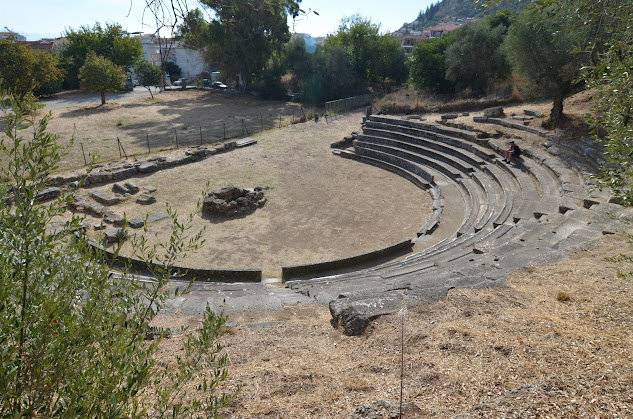
Although Gythio or Gytheio wasn't on my wish list, today it was nevertheless more than worthwhile the visit. Gythium was the seaport of ancient Sparta, some 40 kilometers (25 miles) north. The city used to be an important port until it was destroyed in 4th century AD, possibly by an earthquake. Also in Roman times Gythium remained a major port and it prospered as a member of the Union. As purple dye was popular in Rome, Gythium exported that as well as porphyry and rose antique marble. Evidence of the ancient Gythium prosperity can be found by the fact that the Romans built this small theatre against a hillside. Although only 8 rows in 4 cunei survived. This is also were the 'thymelic' performances used to take place. The thymelic was a song contest dedicated to Dionisos, which included a parade and a sacrifice to the Roman emperors. Today, although the site is abondoned, there are some cultural events taking place in this theatre every summer, as part of the F...

Theatermask of Eleia

Afbeelding
Yesterday, I visited the splendid exhibition 'Mythos Olympia: Kult und Spiele' in Martin-Gropius-Bau in Berlin. The exhibition gave a thorough inside in the Olympic games, which were held in de Greek region of Elis, Eleia ( Ἦλις) or modern Ilida,  in southern Greece on the Peloponneso peninsula, bounded on the north by Achaea, east by Arcadia, south by Messenia, and west by the Ionian Sea. The first Olympic festival was organized in Elean land, by the authorities of Elis in the 8th century BC, with tradition dating the first games at 776 BC. The Hellanodikai, the judges of the Games, were of Elean origin. Elis held authority over the site of Olympia and the Olympic games. The spirit of the games had influenced the formation of the market: apart from the bouleuterion, which was housed in one of the gymnasia, most of the other buildings were related to the games, including two gymnasia, a palaestrum, and the House of the Hellanodikai.   T...

The Theater of Dionysos

Afbeelding
The theater of Dionysos is not only one of the oldest, but also one of the most wonderful Greek theaters in the world. Much has been written about it, so it is a little bit silly to copy wikipedia, or the Encyclopedia Britannica, for those more attached to the old school. Nevertheless, I will give a very brief description of its purpose. The theater of Dionysus is integrally connected to "one of the most brilliant creations of the ancient Greeks: drama, the ancestor of the modern theater". The prevailing view on the birth and development of ancient Greek drama lies in the improvised song that the faithful sang as they danced in honour of Dionysos, god of vegetation, wine and intoxication. Gradually, with the introduction of new elements, the song developed into the first complete theatrical expression of the western world, ancient Greek drama; tragedy, satyr and comedy, perfected in the 5th century BC. We all have heard of the three great tragic poets, Aeschylus, Sophocl...

Dionyosos in his own theater

Afbeelding
Visiting the National Archeological Museum in Athens is quite an experience. Although I knew that most of the Roman statues I love, are copies of Greek originals, it still gives a shock being confronted with the Greek original itself. This specific statue of Dionysos was made in the 1st century AD, as a copy of the original made by Praxiteles, about 325-320 BC. It was found in the Theater of Dionysos in Athens at the slope of the Acropolis. It belongs to the so called 'Dionysos-Sardanapalus' type. Praxiteles of Athens, was the most renowned of the Attic sculptors of the 4th century BC. He was the first to sculpt the nude female form in a life-size statue, which probably added extremely to his popularity! Or, as someone wrote: "The disillusionment with civic values caused by the Peloponnesian War had turned artistic taste away from the idealism of Phidias's art toward a more humanized, personal view of the world and the gods. Praxiteles brought the gods down to a hu...

Odeon of Herodes Attikos

Afbeelding
This photo of the odeon of Herodes Attikos in Athens, I kindly received from Tijs van Uffelen, my personal fitness coach. He visited the acropolis last month and was, like so many people before him thrilled by the site. Due to the dept position of Greece, it has been suggested that the acropolis of Athens might be one of the objects to be privatised. Especially, while currently the entrance fee is about 10 euro per person, while other highlights in Europe are much more expensive to visit; making clear there is much more to earn by just increasing the ticket prices for the thousands of tourists visiting Athens annualy. During my visit to Athens in 1988, I already visited the acropolis and the odeon (read my earlier entry ). Looking at Tijs' picture it is still a stunning place to visit.

Greek masks at Allard Pierson

Afbeelding
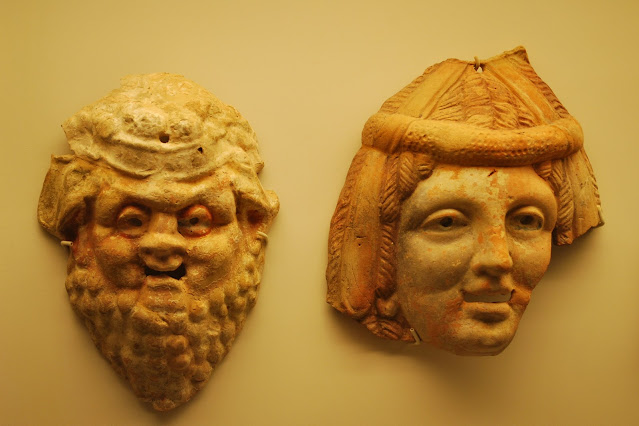
These miniature terracotta masks are on display at the Allard Pierson Museum in Amsterdam. They were made in ancient Centuripe, west of Catania, Sicily, 100-300 BC. Together with other finds they were discovered in a cemetery, a setting that establishes a devotional context for their production. They emulate types of full-size theatrical masks that were used in performances of New Comedy , popular throughout southern Italy and Sicily from the late fourth century BC to Roman times. The subjects of these comedies were derived largely form day-to-day activities of family life and revolve mostly around improbably romantic entanglements. Like a master falling in love with an employee. New Comedy masks typically represent stock comedic characteristics such as prostitutes of all ages, masters and slaves, young and old men, parasites, flatterers, and musicians.  Especially the right one at the lowest picture, drew my attention. I...

Thassos

Afbeelding
The Greek theater of Thassos dates from the 2nd century AD. This picture was taken by Ramón Putzer, who visited the island last summer. It is wonderfully situated at the slope of the mountain. Unfortunately, I can't find any proper information about its history.  Anyone who has any details, please sent me a message at rienbongers[at]yahoo[dot]com!

Hypata's theater in 'the Golden Ass'

Afbeelding
This week I read Apuleius' 'The Golden Ass' or 'Metamorphoses'. Lucius Apuleius (ca. 125-180), wrote this great novel which contains various ludicrous adventures. The central character 'Lucius' is accidentally turned into an ass by using magic. Only the eating of roses can undo his transformation. The story unfoldes in Hypata.  Hypata (τὰ Ὕπατα) is a town of the Aenianes in Thessaly, south of the Spercheus in Greece, whose inhabitants were notorious for witchcraft. Herodotus mentioned a nearby spring. During the Second Macedonian War, it was a village of the Aetolian League. After it, Hypata became a city of the Roman province of Achaea. Its archaeological findings from that time dates back to around the 2nd century. Before his transformation Lucius is put on trial for murder; with the theater of Hypata used as a courtroom. Unfortunately, I can't find any archeological references to this theater. Either it was made of wood, not yet excavated, completely...

Callas als Medeia

Afbeelding
De akoestiek van het theater van Epidauros is legendarisch. Het was goed genoeg voor Maria Callas om er in 1961 als Medeia te schitteren. Dit schijnt van een ongehoorde schoonheid te zijn geweest. Griekenland bracht in 1980 voor haar een herdenkingszegel uit. Hierop wordt gerefereerd aan dit optreden. Ik vond slechts een korte stommefilm opname van één van haar repetities voor dat optreden. Mét geluid moeten we genoegen nemen met een fragment van haar optreden als Medeia in Covent Garden in 1959. Euripides is de eerste Griek sinds Homeros die zich interesseerde voor positie van de vrouw in de oude patriarchale maatschappij. Hij maakt dat echter niet makkelijk door de Oosterse prinses Medeia ten tonele te voeren. Deze vermoord zo'n beetje iedereen die ze tegenkomt; haar broer, haar rivale, diens vader en zelfs haar eigen twee kinderen. Euripides heet de wegbereider van het psychologisch theater en de zedenkomedie. De tragedie Medeia werd voor het eerst opgevoerd in 431 v.Chr. en ...

A birds eye view of Epidauros

Afbeelding
Als afgevaardigde van een Nederlandse studentenvereniging bezocht ik in oktober 1988 een international seminar van Youth for Development and Cooperation (YDC). In Athene speelden we een rollenspel, waarbij ik het rijke, perverse 'noorden' mocht vertegenwoordigen. Na afloop reisde ik nog een week over de Peleponessos. Met een tweedehands Italiaans tweetjasje van Steppin' Out, streepjesoverhemd, broques en rugzak, een nog steeds memorabel 'kijk mij eens' moment. Het is fijn om in een kleine kroeg aan de voet van de Acropolis 'Hadrianus Gedenkschriften' van Yourcenar te lezen. Epidavros was na Athene mijn tweede ontmoeting met een 'echt' Grieks theater. Je moet een stukje klimmen voordat je het bereikt. Bovenaan de heuvel ploeg je je door laurierstruikjes en ineens kijk je uit over een van de mooiste klassieke theaters ter wereld. Deze foto is gejat, want ik had nog geen eigen piper cub. Een spectaculair gebouw, voor zo'n 14.000 bezoekers. Een fil...

Odeon van Herodes Attikos

Afbeelding
Wanneer je op de acropolis van Athene de Stoa van Eumenes langswandelt bereik je het Odeon van Herodes Attikos. Het is de schitterende stadsgehoorzaal van Athene, gebouwd omstreeks 160 n.Chr. Het is aan de stad geschonken door de bankier Herodes Attikos van Marathon. Oorspronkelijk schijnt het toneel, maar misschien zelfs het hele theater, overdekt te zijn geweest met een cederhouten plafond. Er konden 6.000 mensen in. Het middenstuk van de voorgevel had twee verdiepingen, de hoektorens elk drie.

Theater van Dionysos

Afbeelding
Tijdens mijn bezoek aan Athene in 1988 maakte ik voor het eerst kennis met een Grieks theater. Dat van Athene is dan geen slecht begin, alhoewel er door mij later indrukwekkender bouwsels zijn bezocht. Het zogenaamde theater van Dionysos dateert uit 330 v. Chr., vroeg-Hellenistisch, en is het eerste dat in marmer is uitgevoerd. De zetels van de priesters van Dionysos op de eerste rang dateren uit de 1e eeuw v.Chr., de skene uit de 2e eeuw n.Chr. Er schijnt reeds al in de 6e eeuw v.Chr. een theater geweest te zijn, maar men zat toen op de grond. Het was bewolkt, maar je kon bij deze man op de foto. Jammer dat ik dat niet heb gedaan. Dat had een mooie foto voor deze blog opgeleverd! Zelf vind ik mijn foto van deze fotograaf nu een soort begin jaren '60 tafereeltje.