Posts

Er worden posts getoond met het label theater

Theater of Igivium

Afbeelding
Vorig jaar bezocht ik het theater van Igivium, net buiten het huidige Italiaanse stadje Gubbio. Het dateert uit 20 vChr. Aanvankelijk had het theater een capaciteit van 3.900 toeschouwers, maar  na een uitbreiding bood het plaats aan 6.000 personen. The theater, built in opus quadratum of rusticated limestone blocks, is a two-story structure: the ground level in opus reticulatus, with vaulted access to the tiers, and the upper store, occupied by the porticus in summa cave, with Doric colonnade. Helaas konden we er niet in want er waren restauratiewerkzaamheden.  Meer foto's van Igivium vind je hier !

Gades or Cádiz

Afbeelding
The ancient theatre of Cádiz in Spain is located on the road along the boulevard, but the entrance is hidden in a side street on the city side. As soon as you enter you will be surprised by beautifully displayed remains and information boards about its history. A corridor brings you to the theater. The city was known as Augusta Urbs Iulia Gaditana when it became a Roman colony, but its primary Latin name in historical and literary sources is Gades. It was built on the old Phoenician predecessor called Gadir.  The theater with a capacity of nearly 20,000 spectators was built during the late Republic, located in new town on island Kotinoussa. Here, I present the texts on display in the museum, which gives a great insight in its history.  The theater was built 'in montibus', taking advantage of the slope of the land to support the stands, whilst modifying it where needed. Architecturally the building stands out for its dimensions, given that the diameter of 118 meters, or 40...

Verulamium at St Albans

Afbeelding
Last year I visited Verulamium - capital of the Catuvellauni - at St Albans near London. It was on my bucket list for quite a while, because it is the only Roman theater visible in Britain today. This time, I took the train from Rotterdam to London and from London to St Albans. Arriving in St Albans it took a half hour walk through the village and passing some Roman remains in a park to reach the remains of the theater. Verulamium was among the first Romano-British towns to be built and by about AD 250 it was the third largest in this Roman province, surpassed only by London and Cirencester. It was not until about a hundred years after the Roman occupation of Britain, that the theatre in Verulamium was built. That might be around 140 AD, with serious alterations through time, until the early fourth century. The stage and seatings were mainly of wood, while the arena and orchestra were covered by a flat cement floor during the fourth major renovation (AD 300).     The tota...

The theater of Cordoba Patricia

Afbeelding
This spring, I visited Córdoba's Roman theatre. The remains can be seen in the basement of the archeological museum. It was built on the south-east slope of the plateau on which the Roman City was founded. The spot chosen for the theatre was located in the new district that emerged in the times of Caesar Augustus, which extended the city limits to the riverbank. Part of the slope was cut away to build the theatre, and massive foundations - almost all of which are still intact today - were laid support the tiered seating area. The construction also triggered the urban development of the entire surrounding area. Important sewage works were undertaken to channel the water flowing down from the city's higher ground.    Foto's gemaakt in het Archeologisch Museum van Cordoba vind je hier !

Theater of Regina Turdulorum (Spain)

Afbeelding
This afternoon, I visited the theater of Regina Turdulorum. About a 1.5 hour drive from Seville, heading north. The excavation is located in a deserted area. Only the hamlet of Reina is within walking distance. There were no other visitors, which added to the serene atmosphere. Pliny mentioned the name of Regina as one of the 'oppida non ignobilia' (or independent community),  located in Baeturia Turdula founded in the layout of the road that runs from Augusta Emerita at Corduba. Among the reasons for founding the city is the mineral wealth of the area. Furthermore, there is political reason, control of the territory of Túrdulo people occupying this area.   The first archeological excavations off the theater, dated mid first century AD, started in the 1970s. At that moment the ruins were known as "The thick wall", referring to the solid concrete remains. The theater was built about the second half of the first century, making use of a soft slope which was used to cons...

Baelo Claudia (Spain)

Afbeelding
My workation, gave me the opportunity to visit 4 theaters and 2 amphitheaters in Andalusia. One of the theaters is in the far south-west of Spain, Baelo Claudia. Originally, Baelo Claudia was the town of the Turdetani, which came a municipium under Claudius. The theater was integrated into the street plan. It has a diameter of 70 meter, facing south to the Ocean. It was built on a slope, with an outer wall of 2,70 meter hight. No seats survived. The orchestra was in front of the stage and was accessible from the side doors. In the south on both sides of the stage are flanked by rectangular buildings, so-called side-halls (parascaenia). A tier (pulpitum) separated the orchestra from the stage and was decorated with marble and painted stucco. Remains of it can still be found today. The 18 meter diameter semicircle at the foot of the auditorium was not just the orchestra pit. A balastrade (balteus) separated the orchestra from the first rows of seats, intended for the city's upper cla...

Ancient Sparta

Afbeelding
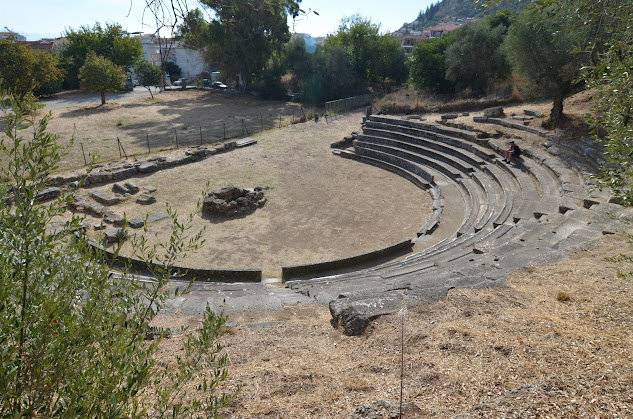
29 October 2017, I visited the theatre of Sparta. It is situated at the southern slope of the Acropolis Hill and was constructed around 30 to 20 BC, and closely connected with the hegemony of Gaius Julius Eurykles, a close friend of Octavian (Emperor Augustus). The Spartan theatre is unique on account of its size and the quality of its construction, evident from the use of local white marble Although we didn't find any remains of an earlier classical theater, the existence of such a theater at the city of Sparta since the 5th century BC is testified by ancient authors. It is closely connected with the celebration of religious ceremonies such as Gymnopaediai . Maybe the ancient building was located at the same position as the current Roman one, but that's unclear. The Roman theater had ten staircases and nine bleachers, while the upper part (the ephitheatron) had seventeen staircases with sixteen bleachers. It is suggested that the construction of a second ephitheatr...

Theater of Gytheio

Afbeelding
Although Gythio or Gytheio wasn't on my wish list, today it was nevertheless more than worthwhile the visit. Gythium was the seaport of ancient Sparta, some 40 kilometers (25 miles) north. The city used to be an important port until it was destroyed in 4th century AD, possibly by an earthquake. Also in Roman times Gythium remained a major port and it prospered as a member of the Union. As purple dye was popular in Rome, Gythium exported that as well as porphyry and rose antique marble. Evidence of the ancient Gythium prosperity can be found by the fact that the Romans built this small theatre against a hillside. Although only 8 rows in 4 cunei survived. This is also were the 'thymelic' performances used to take place. The thymelic was a song contest dedicated to Dionisos, which included a parade and a sacrifice to the Roman emperors. Today, although the site is abondoned, there are some cultural events taking place in this theatre every summer, as part of the F...

Faience mask

Afbeelding
In February, I visited the Metropolitan in New York and saw this magnificent Faience masks, discovered in Medinet-el-Fayum at Antinoopolis, Middle Egypt. It dates from the 2nd century AD. With reference to the The Metropolitan, the masks are too small and brittle to have served as actual theater masks. They refer to the god Dionysus, patron of the theater and god of rebirth: in Egypt equated with Osiris. Terracotta masks are found in burials and sanctuaries in Greece, in sanctuaries and as garden decorations in Italy. In Egypt they are known only from burials, as offerings to Osiris, Dionysus. More of my pictures of the Metropolitan can be seen  here .

Scolacium, hidden and exclusive

Afbeelding
Departing from Rome, a six hours journey by train brought me to Calabria. Here, I visited the ruins of the Greek city of Schilletion, or Roman Scolacium. An insiders tip away from the more crowded Tyrrhenian Sea and Vibo Valentia. Although the city is the birthplace of Cassiodorus (480-575), I was primarily interested in the small and intimate and very well preserved Roman theater, shown below. Originally built during the Greek era, the present building is Hadrianic. Due to its late Hellenistic origin, a small temple (or Frova) was built behind. A similar find was recorded at  Teanum Sidicinum . The theater is built against the hillside on concentric and radial support walls. The outer cavea wall is remarkably (still) decorated in opus reticulatum. Although it is forbidden to enter the structure, my curiosity and ambition to get some good pictures for this blog made me to become a trespasser, again. I c...

Theatermask of Eleia

Afbeelding
Yesterday, I visited the splendid exhibition 'Mythos Olympia: Kult und Spiele' in Martin-Gropius-Bau in Berlin. The exhibition gave a thorough inside in the Olympic games, which were held in de Greek region of Elis, Eleia ( Ἦλις) or modern Ilida,  in southern Greece on the Peloponneso peninsula, bounded on the north by Achaea, east by Arcadia, south by Messenia, and west by the Ionian Sea. The first Olympic festival was organized in Elean land, by the authorities of Elis in the 8th century BC, with tradition dating the first games at 776 BC. The Hellanodikai, the judges of the Games, were of Elean origin. Elis held authority over the site of Olympia and the Olympic games. The spirit of the games had influenced the formation of the market: apart from the bouleuterion, which was housed in one of the gymnasia, most of the other buildings were related to the games, including two gymnasia, a palaestrum, and the House of the Hellanodikai.   T...

The theater of Segobriga

Afbeelding
Segobriga was the chief town of Celtiberia, near modern Sealices. I visited this beautiful excavation at August 8, just hours before flying back to Schiphol Airport. The theater of the city is beautifully situated near the walls of the ancient city, only 50 metres east of the amphitheater. This Roman building is using the slope of the mountain, and is cut into the limestone hillside. Most of the ima and media cavea and parts of the scene building are preserved. It had a capacity of about 1,650/ 2,050 spectators.  It was built about 40-60 AD. It scanea frons was remodelled late 1st century, early 2nd century AD. This airial view shows the ancient city at it is today, and decorates the entrance hall of the small museum near the entrance of the archeological area.  More pictures of Segobriga can be seen here !

Theater of Colonia Augusta Merita (1)

Afbeelding
August 1, I visited this breathtaking theater in Merida. Colonia Merita Augusta was founded in 25 BC and capital of Lusitania, one of the most important towns in Spain. A beautiful small booklet with the above picture goes with the entrance ticket. The excavations started in 1910 and marks "a milestone" in the history of archeological activity at Merida. The booklet states: "Such buildings, built for political motives, did not reflect the tastes of the public, which tended to prefer circus and amphitheater entertainments. From the theater, the ruling authority achieved effective propaganda, for itself and for the Roman way of life, both through the actual building - its physical grandeur, epigraphs and iconography - and through the messages that could be transmitted from the stage. In Augusta Merita, it was the consul Marcus Agrippa who promoted the building of the theater, which was inaugurated between 16 and 15 BC., on the evidence of t...

Masks of the New Comedy and Tragedy

Afbeelding
The second week of July, I visited the Archeological Museum in Athens. An incredible treat for anyone who likes Greek and Roman art. Among its many treasures, I saw these masks, made of pentalic marble on display. This mask was found at the west side of the Stoa of Attalos in Athens. It depicts the type of a young woman or courtesan of the New Comedy. She has luxuriant hair and wears large earrings. It is identified as a Late Hellenistic copy of a type of the 4th century BC. This mask of 'the impudent slave' was found at the same location as the courtesan above, and is also a late Hellenistic copy of an original of the 4th century BC. His features, flat nose, huge open mouth and deeply wrinkled forehead render this type. Found in Dionysos at Attica, this mask is worked in the round type of a female figure of tragedy. It is dated 3rd century BC. This bearded old man with his very high forehead and open mouth is probably the 'first old man', of the New Com...

The Theater of Dionysos

Afbeelding
The theater of Dionysos is not only one of the oldest, but also one of the most wonderful Greek theaters in the world. Much has been written about it, so it is a little bit silly to copy wikipedia, or the Encyclopedia Britannica, for those more attached to the old school. Nevertheless, I will give a very brief description of its purpose. The theater of Dionysus is integrally connected to "one of the most brilliant creations of the ancient Greeks: drama, the ancestor of the modern theater". The prevailing view on the birth and development of ancient Greek drama lies in the improvised song that the faithful sang as they danced in honour of Dionysos, god of vegetation, wine and intoxication. Gradually, with the introduction of new elements, the song developed into the first complete theatrical expression of the western world, ancient Greek drama; tragedy, satyr and comedy, perfected in the 5th century BC. We all have heard of the three great tragic poets, Aeschylus, Sophocl...