Posts

Er worden posts getoond met het label circus

Gladiators and charioteers in Noviomagus

Afbeelding
This morning I visited museum Het Valkhof in Nijmegen, at Oppidum Batavorum or Ulpia Noviomagus Batavorum . Het Valkhof is a remarkable museum with an extraordinary fine collection of Roman finds, both from the vicus and the military settlements. Among these finds are two beautiful objects, a green glazed bowl and a terra sigillata jar. One shows fighting gladiators and the other one a racing chariot. This well preserved bowl shows fighting gladiators in an amphitheater. A heavy armoured gladiator attacks his opponent, armed with trident and dagger. At the opposite side you can see a referee, carrying a stick, intervening. The bowl was made in Cologne (Colonia Claudia Ara Agrippinensium) and capital city of Germania Inferior, probably at the end of the 2nd century AD. It was found at the cemetry of Noviomagus. The second object is this terra sigillata jar, decorated by three medailions. One with a deer, one with a dog, and the one shown here, with a quadriga. The driver show...
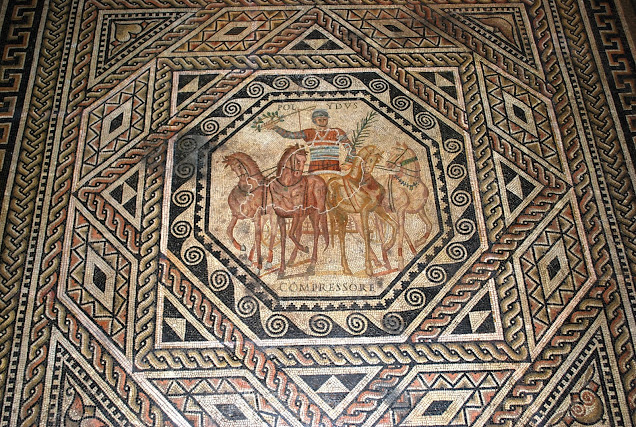
Polydus, champion charioteer for the reds

Afbeelding
Last week, I visited Landesmuseum Trier for the third time, which probably sounds boring but its collection is of great quality. The museum was renovated a few years ago, so a good excuse to visit it again. In my previous blog post I already wrote that the circus of Colonia Augusta Treverorum dates back to the earliest period of the cities history. The race track may have been created immediately after the city was founded. Quite some interesting finds, referring to the circus are in Landesmuseum Trier on display, including this mosaic of Polydus, a popular charioteer for the red faction (factio russata), and his lead horse Compressor. He is taking a victory lap. My picture is the centerpiece of a mosaic floor from a villa in front of the Imperial Baths in Trier. The representations on Roman mosaics of the victorious charioteer of the circus may be compared with similar representations in other forms of Roman art, both major and minor. Certa...

Fountains on the spina in Trier

Afbeelding
The circus appears to date back to the earliest period of the history of Trier or Colonia Augusta Treverorum ; the race track may have been created immediately after the city was founded. However, the hippodrome, which was about 450 meter long, became truly monumental in the first half of the second century. It was renovated after 293, when Constantius Chlorus moved his residence to Trier. We know that the monument was connected to the aqueduct, and we may assume that there were fountains on the spina . On this photograph, taken of a model in Landesmuseum Trier last week, you can see that the circus is at the outskirts of city. You can't see that is quite near the amphitheater, which was integrated in the city wall.  The circus vanished completely. Currently the whole area is covered with houses. Heinz Cuppers, writes in 'Die Romer in Rheinland-Pfalz', that the circus was one of  the first buildings to be destroyed by the new inhabita...

A circus at Brindisium?

Afbeelding
The Lonely Planet starts the chapter 'History of Brindisi', with the following lines: "There is a great scene in the film Spartacus where Kirk Douglas enthusiastically exclaims to sidekick Tony Curtis that they are 'off to the Roman city of Brundisium!' And there, where the Appian Way meets the port, ships would lie waiting to take Spartacus and his great army of freed slaves off to Greece."  Spartacus was double-crossed in Brindisium, southern Italy's busiest merchant and passenger port for centuries. Although I couldn't find clear references to a circus or ampitheater, it is clear that taking the importance of the city in mind, both public buildings must have existed during the time of Spartacus. I wonder whether his men visited the amphitheater. For some of them common ground.   I couldn't find any proper information about these buildings on the internet, although the Dutch historian Fick Meijer mentioned Brindisium in his book 'Chariot...

Circus of Maxentius

Afbeelding
Yesterday, I arrived in Rome and visited the circus of Maxentius. It is the best preserved circus in Rome, and an attractive scenic site. It was excavated by Antonio Nibby in 1825 for the Torlonia family, and restored in the 1960s and 1970s. The stadium measures 513m by 91m and was probably capable of holding some 10.000 spectators. The main entrance was on the west side with the 12 carceres or stalls for the chariots and quadriagae, and, on the other side, two square towers with curved facades. Two arches, one of which has been restored, connected the towers to the long sides of the circus and provided side entrances. I n the construction of the tiers of seats, amphorae were used to lighten the vaults and these can still clearly be seen. In the centre of the left side is the conspicuous emporer's box, which was connected by a portico to his palace on the hill beside. At the far end was a triumphal arch where a fragment of a dedicatory inscription to Romulus, son of Maxentius, w...

Victoria supports Factio veneta

Afbeelding
Yesterday, I visited Atuatuca Tungrorum, or modern Tongeren in Belgium. A brand new museum, the Gallo Romeins Museum, shows the many Roman finds in the region. Like this gemstone of lapis lazuli, once part of a precious ring.  It shows Victoria with a Quadriga; a chariot with four horses. Next to the beauty of the stone, the colour reflects the preference of the bearer: Blue! So the Goddess Victoria is now favouring the Factio veneta. Lapis lazuli is said to possess strenghtening qualities. The gemstone was found in Tongeren and dates between 100 and 200 AD. Atuatuca Tungrorum is notorious because of the battle of Atuatuca , which took place at 54 BC. The Eburonian leader Ambiorix destroyed a legion. More pictures of the Gallo Romeins Museum can be found here !

Green, red, blue or white?

Afbeelding
This stunning Roman oillamp shows a racing chariot with two horses, or a biga. It is beautiful, primarily due to its almost childish simplicity. In my opinion it is one of the best objects of the Römisch Germanisches Museum in Köln. At the end of the first century AD, Rome had four racing stables. Each with a substantial amount of supporters, called factiones. These factiones were called 'the Green' (factio prasina), 'the Blue' (factio veneta), 'the Red'(factio russata) and 'the White' (factio albata). These four racing stables were of sociatal importance and had political significance. Even the Emporer had its favourite stable. This oillamp, found in Köln shows the popularity of chariot racing in the Roman world, while in Germania, only Trier had a hippodrome of significant size: 440 by 86 meters. More of my pictures of oil lamps you can find here !

MIRANDVS, my favorite horse!

Afbeelding
This playpiece, at display in Cologne, was used in a game as 'racehorse'. Can you imagine a Roman, concentrating on etching the name of his favorite horse, 'MIRANDVS' or 'To be admired', in this stone? Fascinating! I don't know how the game was called nor its rules - probably 'Latrunculi' -, but I will soon find out. More of my pictures at C(laudia) C(olonia) A(ra) A(ggripensium) or Cologne, can be found here .

Get the right idea: Ben Hur!

Afbeelding
Until this moment, I have posted three messages on circuses. Those of Caesarea, Tarraco and Aphrodisias, and will add more in the future. To learn more about chariot racing? Watch Ben Hur, 1959! When a Jewish prince is betrayed and sent into slavery by a Roman friend, he regains his freedom and comes back for revenge. A movie by William Wyler, with our rifle friend Charlton Heston and Jack Hawkins (remember the movie: 'Poppies are also flowers',... ?). Winning 10 (ten [sic!]) Oscars! Enjoy !

The circus 2009

Afbeelding
As written in an earlier message, the Tarraco circus was a huge construction. Looking closely, you can find many remains of the Roman city in modern buildings. I was thrilled to find a portico of the circus, conserved in an office of the bank 'La Caixa' at the Placa de la Font. It is great how the remains have been preserved within this modern office.

To the circus of Tarraco!

Afbeelding
This beautiful wooden model, gives an idea of the splendour of the circus of Tarraco during Roman times. It was build during the reign of Domitian (81-96 AD). It was rectangular in shape, some 325 meters long and with a width that varied between a 100 and a 115 meters. It occupied the width of the city (!), from one wall to the other. The circus was the setting for one of the most popular spectacles in ancient times: the chariot race. The splitterwall, or spina , was decorated with commemerative monuments of the city or specific benificiaries. Looking at the picture above, you can hardly imagine that this construction was once a lively scenary of chariot and horse racing. Nevertheless, the city tries to recover some of its ancient past. The blind wall of the 'soon to be demolished' building, visualizes the place where we are in the picture. A clever way of documentary. In his book 'Wagenrennen' or 'Chariot racing', Fik Meijer, professor Ancient History at the...

Herod's hippodrome

Afbeelding
One of the most impressive constructions in Caesarea is the Roman hippodrome, or racecourse for horses and carriots. Herod himself ordered its construction, shortly after he founded the city. It was 300 meters long and fifty meters wide. About 15,000 seats are counted! Of both constructions, theater and hippodrome, you can watch a 3D animation . More pictures of Caesarea you can find: here !

Aphrodisias' Circus

Afbeelding