Posts

Er worden posts getoond met het label Italy

Theater of Igivium

Afbeelding
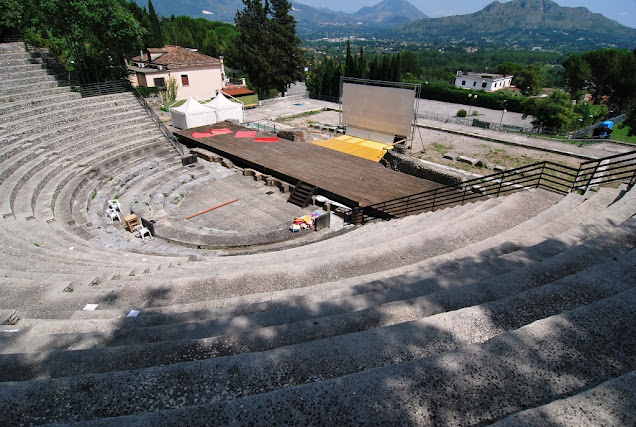
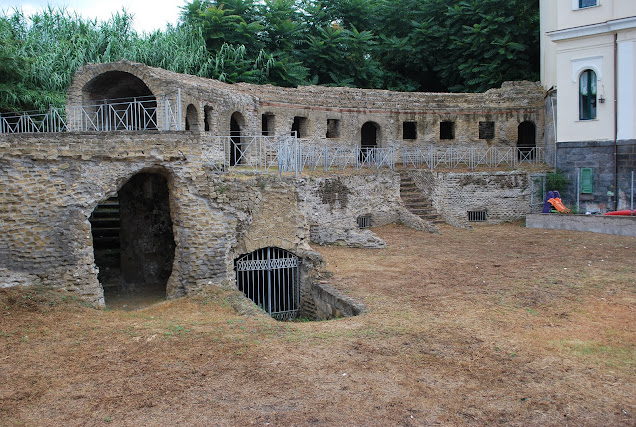
Vorig jaar bezocht ik het theater van Igivium, net buiten het huidige Italiaanse stadje Gubbio. Het dateert uit 20 vChr. Aanvankelijk had het theater een capaciteit van 3.900 toeschouwers, maar  na een uitbreiding bood het plaats aan 6.000 personen. The theater, built in opus quadratum of rusticated limestone blocks, is a two-story structure: the ground level in opus reticulatus, with vaulted access to the tiers, and the upper store, occupied by the porticus in summa cave, with Doric colonnade. Helaas konden we er niet in want er waren restauratiewerkzaamheden.  Meer foto's van Igivium vind je hier !

Scolacium, hidden and exclusive

Afbeelding
Departing from Rome, a six hours journey by train brought me to Calabria. Here, I visited the ruins of the Greek city of Schilletion, or Roman Scolacium. An insiders tip away from the more crowded Tyrrhenian Sea and Vibo Valentia. Although the city is the birthplace of Cassiodorus (480-575), I was primarily interested in the small and intimate and very well preserved Roman theater, shown below. Originally built during the Greek era, the present building is Hadrianic. Due to its late Hellenistic origin, a small temple (or Frova) was built behind. A similar find was recorded at  Teanum Sidicinum . The theater is built against the hillside on concentric and radial support walls. The outer cavea wall is remarkably (still) decorated in opus reticulatum. Although it is forbidden to enter the structure, my curiosity and ambition to get some good pictures for this blog made me to become a trespasser, again. I c...

Pompéi. Les Nouvelles Fouilles et l'Amphithéâtre

Afbeelding
On June 4, I celebrated my 52th anniversary and received a very special gift from my friend Marty. An old travel guide: "Pompei: Les Nouvelles Fouilles (Maisons et Habitants) et l'Amphithéâtre. Ouvrage illustré de 47 Figures". This small treasure dates from 1944 and once belonged to the 'Direction des Antiquites de l'Algerie'. A special section is dedicated to the amphitheater. Herewith, I quote a part of the paragraph 'L'Amphithéâtre', of this lovely booklet: "L'Amphithéâtre de Pompéi ne se trouve ni parmi les plus grands, ni parmi les plus remarquables des édifices de ce genre, main c'est le plus antique. Il a été construit en effect peu après l'an 80 avant J.C. par deux riches magistrats Caius Quintius Valgus et Marcus Porcius à la suite de leur victoire aux élections. Ils supportèrent tous les frais de sa construction et en firent don à la Cité pour y présenter des spectacles de gladiateurs. Il était accessible par le...

Amphitheater of Casinum

Afbeelding
The amphitheater of Casinum, erected by Ummidia Quadratilla (whose passion for actors is mentioned by Pliny, Epist. vii.24, on the occasion of her death, and quoted in my post about the theater of Casinum, still exists. She was a wealthy Roman aristocrate and a member of the gens Ummidia. She died in the reign of Emperor Trajan (98-117) within a little of eighty years of age, leaving two-thirds (ex besse) of her fortune to her grandson and the other third to her granddaughter. Her grandson Ummidius Quadratus was an intimate friend of Roman Senator and historian Pliny the Younger, who praises her for fostering Quadratus' studies while keeping him untouched by her own luxurious lifestyle. Quadratilla was probably a sister of Gaius Ummidius Durmius Quadratus, the governor of Syria, who died in 60, and appears to be the same as the Quadratilla mentioned in the following inscription, discovered at Casinum in Lazio: "Ummidia CF Quadratilla amphiheatrum et templum Casinatibus sua pe...

Plinius minor at Casinum

Afbeelding
It is hard to enter the theater of Casinum; or actually, it is only open during performances. Although it is almost in the backyard of the archeological site - containing the museum, amphitheater and a beautiful part of the Via Latina - the theater belongs to the municipality of Cassino, without actively promoting visits. Trespassing, climbing over a fence and quickly making snapshots is the only way to get a glimps; look at the results ! It is also hard to find the museum, like most of the archeological sites in Italy, because of a lack of signposts. In addition, Monte Cassino is the main attraction in the region and the theater and wonderful amphitheater (see my other blogentry) seems to be regarded as old trash. To get an idea of the once lively stage, I copied a letter of Plinius the younger, who visited the theater and wrote to his friend Geminius about the remarkable benefactress Ummidia Quadratilla and her 'set of pantomimes'. From: Plinius Minor, Book VII, Lette...

Walking through the theater of Saepinum

Afbeelding
Very close to Napels, Sapino or in Latin Saepinum, is one of the best-preserved examples in Italy of a small rural Roman town. We are now in Molise, a mountainous and largly unspoiled area of Italy. The site of Saepinum, itself, is at the crossroad of two important and truly ancient trails: the north-south trail along the Tamaro Valley was used long before the presence of the Romans at the path of the transumanze, the seasonal migration of shepherds and livestock into Puglia and Campania. That trail was crossed by the east-west path leading through the mountains of the Adriatic. Saepinum is virtually on top of a Samnite town, which the Romans conquered in 293 BC. The theater was part of the city wall and it was possible to enter the theater from outside the city through a narrow entrance. The cavea has a diameter of 61,5 meter and the orchestra measures 22,9 meter. It gave room for 3,000 spectators. Perry made a great video walking through the ambulacrum of the theater: watch ...

Amphitheater of Lucera

Afbeelding
The amphitheater of Lucera is one of the oldest in Italy. Newly renovated, it looks like a stadium of Mussolini, a little bit like the Foro Italico in Rome. Nevertheless, despite the nervous behaviour of a hysterical attendant, we enjoyed walking around the arena and imagined to be guest during the once lively activities. The amphitheater is extraordinary large (its outer dimensions are 126.8 meter long by 94.5 meter wide), and could accomodate 16.000 up to 18.000 spectators. It was built between 14 and 2 BC. As told by the inscription on the entrance gate, it was built on a private land and paid by Marco Vecilio Campo, a magistratus, in honor of Emperor Augustus and the local community. Overall, the amphitheater has a rather simple architectural and decorative structure: over the main portal we find a shield and a spear in bas-relief, that remind of the gladiatorial shows hosted in the arena, or maybe the military rank of Vecilio Campo. More of my pictures of Lucera, you can ...

Egnazia

Afbeelding
Egnazia dates from the 13th century BC, but it really flourished between the 5th century BC until end of the Roman era, while its position between Peucetia (Bari province) and Messapia (the Salento) made it a vital link along the Via Appia serving Rome. The only remains now, are the foundation stones of houses and backeries, roads and graves.  The amphitheater shown beneath, is an open elliptical building. Its wall used to be plastered and painted. The remains of this structure consists in the upper paved walkway. To enter the building there were two symmetric pairs of entrances (one of these was the monumental entry) and the interior was made of clay. The use of the building dates back to the 1st century BC, is disputed. It could have been used as market place or for entertainment and performances in honeur of the oriental divinities worshipped in the near shrine.  I was quite impressed by the beautiful piece of pavement of the Vi...

A circus at Brindisium?

Afbeelding
The Lonely Planet starts the chapter 'History of Brindisi', with the following lines: "There is a great scene in the film Spartacus where Kirk Douglas enthusiastically exclaims to sidekick Tony Curtis that they are 'off to the Roman city of Brundisium!' And there, where the Appian Way meets the port, ships would lie waiting to take Spartacus and his great army of freed slaves off to Greece."  Spartacus was double-crossed in Brindisium, southern Italy's busiest merchant and passenger port for centuries. Although I couldn't find clear references to a circus or ampitheater, it is clear that taking the importance of the city in mind, both public buildings must have existed during the time of Spartacus. I wonder whether his men visited the amphitheater. For some of them common ground.   I couldn't find any proper information about these buildings on the internet, although the Dutch historian Fick Meijer mentioned Brindisium in his book 'Chariot...

Theater of Lupiae or Lecce

Afbeelding
The theater of Lecce or Roman Lupiae was originally built during the reign of Augustus and rebuilt early 2nd century AD. It is located in the center of town, only 100 meter west of the amphitheater. As you can see it has a well-preserved orchestra and 12 rows of seats. It also seems to have a well-preserved  hyposcaenium,  situated under the pulpitum and the back side of the stage building, but could not be visited. Currently, the theater is completely surrounded by modern houses, but can be perfectly viewed from a passage above.     While the theater itself is a stone colossus, you could once enter or leave the building to visit a garden or peristylium ; see the model at display in the museum above.   During the excavations various statues were found, which are now in the museum, like the torso of an amazon, Athena, Artemis en Ares. For more pictures of Lecce, click here !

Greek theater play on vase Matheola

Afbeelding
This comic phylax scene, I found at a krater on display in the museum of Matera, or Greek Matheola. The term phylax, applied both to the actors and to the plays themselves, and, through a modern extension, to the vases that portray them. It is found in the writings of several ancient authors.  This parodic, comic or even farcical tradition encouraged by the freshness of a new figurative language developed as less codified than that of Athenian painters. From 440 BC on, these red-figured vases were produced in Magna Graecia, so also in southern Italy. You can find pictures of them in sets of Matheola and Lecce ; all at my Flickr account. I couldn't find out which scene has been presented. The information available said: 'Cratera a campana apulo a figure rosse. 360-340 BC. Pittore di Graz. Scena teatrale'.

Metapontum: ekklesiasterion and theater

Afbeelding
Yesterday afternoon, I visited the Museo Archeologico Metaponto and the archeological site of Metapontum in Basilicata. The museum, a modern building at the outskirts of the village, possesses a beautiful collection of ancient Greek artefacts. It is odd, or better quite frustrating that no brochures or booklets are available or even for sale. Most irritating is that photography is prohibited. Where the Louvre, Getty or Neues Museum allow people making pictures, the Museo Archeologico Metaponto, does not! An investigation for the reason of this strange ban, was not very successful. A small woman with mustache was walking around like a prison warden, making my visit feel like an illegal operation. The theater however is a special case. It is located in the archeological park. Primarily it was built as an ekklesiasterion, in a circle, which can be seen in the artist impression below. Much is known about the construction which can be found here . More pictures of the theater and some...

Sybaris

Afbeelding
During my trip to Calabria in 2011, visiting Roman Colonia Copia or Greek Sibari, was one of the astonishing highlights. Amidst a rather depressing countryside, next to a huge EU funded but empty car park, abandoned restaurant and permanently closed gift shop, the Augustian theater is one of the only remaining buildings to visit. Only parts of the outer curved wall, lowest seats, and footings of the scene building remain. The substructures show about three major building periods. I couldn't find any information regarding its capacity, but the the orchestra measures 20,5 meter and the cavea has a diameter of 68. Comparing this size with other theaters, it might have contained around 5,000 spectators. Just a guess.   More pictures of Colonia Copia or Sybaris can be found here ! More on wikipedia .

Odeon of Posillipo

Afbeelding
Italy is a beautiful country, but it is sometimes difficult to understand the rationale behind the opening hours of many of its monuments. The Imperial Villa at Pausylipon, restored by - as so much in Italy - EU funds, was closed. Why? I can't think of any reason, instead of that the restored villa doesn't add to any pride, or a lack of 'ownership', or just because of the imcompetance of the Italian management. Therefore this picture of its odeon had to be taken by a zoom lense. During the late republican period a magnificent residential complex was bulit on the hillside facing Sorrento. In its heyday, this villa covered an area of approximately 9 hectares including gardens, a theater, baths, vines and finds ponds. Historical sources cite the Roman knight Publio Vedio Pollione, a rich freed man originally form Benevento, as the first owner of a large villa built on the site which he called Pausilypon (meaning respite from pain in Greek) a modified version of which came ...

The tame lions of Puteoli

Afbeelding
As testified by little glas flasks, little glass souvenirs which the travellers of Roman times took away from their visit to Puteoli, the Flegrian city was famous due to the presence of two amphitheaters in its center, a privilege which no other Roman city, other than Rome, could claim. Of the smaller, pre-Augustian, older amphitheater, little is known, while destroyed during the construction of the Naples-Rome railway. It seems that the older arena was used for gladiator shows and the new one hosted venationes, great exotic animal hunts of which Puteoli was the largest importer of the Roman world. This story is about the larger and also newer one. The large amphitheater of Puteoli is of great size and beauty. After the Colosseum and the one of Capua , it was the third largest in Italy. It measured 149 metres x 116 metres with a capacity for 40.000 specatators. It is unclear when the building was built exactly; it has been dated as been constructed during the Flavian period, ...

Agrippina's tomb at Bacoli

Afbeelding
The Roman building on the beach of Bacoli, identified as Agrippina's tomb in the nineteenth century, is actually a theater (probably an Augustan Odeion, similar to the one in Baia), converted to a ninfeo for water sports around the beginning of the second century AD because the effects of bradyseism meant that it was gradually sinking into the ground. As so many of the ancient buildings in Italy, it was hard to find and in the end a little bid disappointing. The surrounding structures have been lost, which make it difficult to work out the various transformations that have occurred over the course of at least three centuries. The theater was probably divided into three hemicycles; two upper, of the same size, and one lower. Even further down (about 1.30 below the level of the beach) a semi-circular board acted as the orchestra pit.

Masks at the Forum of Cumae

Afbeelding
This great, almost modern sculptures, were found at the forum of Cumae, in an area now called 'the portico of the masks'. They date from the first half of the first century AD. The masks are made of grey tufa, and although time left its traces, they are still of good quality. The masks are at display at the Museo Archeologico Dei Campi Flegrei at Bacoli.

A green grapevine: the amphitheater of Cumae

Afbeelding
One of the best hidden ampitheaters of 'Campi Fregrei' or 'lands on fire', named after the once numerous vulcanic wells and activities, is the amphitheater of Cumae. We have been searching for it for almost two hours. Due to a incorrect signpost, but also because the entry is along a narrow, obscure road and the amphitheater is on private property, it almost escaped our hunt. The reward, once at the site, was worth while the effort. While still partly unexcavated, it gives you the impression you are one of the first visitors with many secrets still to be revealed. Cumae (Italian; Italian: Cuma, Ancient Greek: Greek: Κύμη Kūmē, Κύμαι Kūmai or Κύ̂μα Kūma) is an ancient Greek settlement lying to the northwest of Naples. Cumae was the first Greek colony on the mainland of Italy (Magna Graecia), and the seat of the Cumaean Sibyl. It was the Cumaean alphabet, as used throughout the Greek island of Euboea, that was adopted in Italy, first by the Etruscans and later by th...

Baia, once a theater, now a nymphaeum

Afbeelding
Visiting the Roman baths at Baia is especially interesting, when you have just read 'Rubicon. The Triumph and Tragedy of the Roman Republic.' from Tom Holland. He describes Roman life in this village in detail; its luxury, its whores and pimps. While Horace once said: "there is nothing in the world more beautiful than the enchanting Baia", for the Romans Baia was synonymous with decadence and curruption. Saint Jerome and Saint Augustine loudly cursed Baia, "a place of perdition of the soul." Attempts to make sense of the complex series of rooms and buildings on the archeological site at Baia started in 1954, but it is constantly being updated as new discoveries are made. One of the landmark features - next to the Temple of Mercury - is the semi-circular terrace of the seaward side. Originally designed as a theater, it is clear from the side walls on the hemicycle and a series of rooms which were carved into the surrounding walls early shows that, at some...

In search for gladiators at Capua

Afbeelding
The amphitheater of Capua, or modern Santa Maria Capua Vetere, was built in the 1st century AD under Augustus and restored by Hadrian and Antoninus Pius. It is a direct copy of the Colosseum in Rome. Its superstructure has suffered much in the course of time and much of the seating and the vaulting upon which it rested are now missing. It is unbelievable that the estimated seating capacity was 47,426! Yet, its subterranean structures remain well preserved and, while they were the first I had seen like this, made a great impression. Only the substructures in Puteoli can rival the ones in Capua. The model in the small museum shows the arena in a much better state than it is at this moment. The subterranean structures of the amphitheater bear a striking resemblance, in their layout, organizational principles, plan and building materials, to those of the Colosseum. However, at Capua there are many more transverse galleries parallel to the minor axis of the arena than in the Col...