Posts

Er worden posts getoond met het label Spain

Gades or Cádiz

Afbeelding
The ancient theatre of Cádiz in Spain is located on the road along the boulevard, but the entrance is hidden in a side street on the city side. As soon as you enter you will be surprised by beautifully displayed remains and information boards about its history. A corridor brings you to the theater. The city was known as Augusta Urbs Iulia Gaditana when it became a Roman colony, but its primary Latin name in historical and literary sources is Gades. It was built on the old Phoenician predecessor called Gadir.  The theater with a capacity of nearly 20,000 spectators was built during the late Republic, located in new town on island Kotinoussa. Here, I present the texts on display in the museum, which gives a great insight in its history.  The theater was built 'in montibus', taking advantage of the slope of the land to support the stands, whilst modifying it where needed. Architecturally the building stands out for its dimensions, given that the diameter of 118 meters, or 40...

The theater of Cordoba Patricia

Afbeelding
This spring, I visited Córdoba's Roman theatre. The remains can be seen in the basement of the archeological museum. It was built on the south-east slope of the plateau on which the Roman City was founded. The spot chosen for the theatre was located in the new district that emerged in the times of Caesar Augustus, which extended the city limits to the riverbank. Part of the slope was cut away to build the theatre, and massive foundations - almost all of which are still intact today - were laid support the tiered seating area. The construction also triggered the urban development of the entire surrounding area. Important sewage works were undertaken to channel the water flowing down from the city's higher ground.    Foto's gemaakt in het Archeologisch Museum van Cordoba vind je hier !

Theater of Regina Turdulorum (Spain)

Afbeelding
This afternoon, I visited the theater of Regina Turdulorum. About a 1.5 hour drive from Seville, heading north. The excavation is located in a deserted area. Only the hamlet of Reina is within walking distance. There were no other visitors, which added to the serene atmosphere. Pliny mentioned the name of Regina as one of the 'oppida non ignobilia' (or independent community),  located in Baeturia Turdula founded in the layout of the road that runs from Augusta Emerita at Corduba. Among the reasons for founding the city is the mineral wealth of the area. Furthermore, there is political reason, control of the territory of Túrdulo people occupying this area.   The first archeological excavations off the theater, dated mid first century AD, started in the 1970s. At that moment the ruins were known as "The thick wall", referring to the solid concrete remains. The theater was built about the second half of the first century, making use of a soft slope which was used to cons...

Baelo Claudia (Spain)

Afbeelding
My workation, gave me the opportunity to visit 4 theaters and 2 amphitheaters in Andalusia. One of the theaters is in the far south-west of Spain, Baelo Claudia. Originally, Baelo Claudia was the town of the Turdetani, which came a municipium under Claudius. The theater was integrated into the street plan. It has a diameter of 70 meter, facing south to the Ocean. It was built on a slope, with an outer wall of 2,70 meter hight. No seats survived. The orchestra was in front of the stage and was accessible from the side doors. In the south on both sides of the stage are flanked by rectangular buildings, so-called side-halls (parascaenia). A tier (pulpitum) separated the orchestra from the stage and was decorated with marble and painted stucco. Remains of it can still be found today. The 18 meter diameter semicircle at the foot of the auditorium was not just the orchestra pit. A balastrade (balteus) separated the orchestra from the first rows of seats, intended for the city's upper cla...

The theater of Segobriga

Afbeelding
Segobriga was the chief town of Celtiberia, near modern Sealices. I visited this beautiful excavation at August 8, just hours before flying back to Schiphol Airport. The theater of the city is beautifully situated near the walls of the ancient city, only 50 metres east of the amphitheater. This Roman building is using the slope of the mountain, and is cut into the limestone hillside. Most of the ima and media cavea and parts of the scene building are preserved. It had a capacity of about 1,650/ 2,050 spectators.  It was built about 40-60 AD. It scanea frons was remodelled late 1st century, early 2nd century AD. This airial view shows the ancient city at it is today, and decorates the entrance hall of the small museum near the entrance of the archeological area.  More pictures of Segobriga can be seen here !

Theater of Colonia Augusta Merita (1)

Afbeelding
August 1, I visited this breathtaking theater in Merida. Colonia Merita Augusta was founded in 25 BC and capital of Lusitania, one of the most important towns in Spain. A beautiful small booklet with the above picture goes with the entrance ticket. The excavations started in 1910 and marks "a milestone" in the history of archeological activity at Merida. The booklet states: "Such buildings, built for political motives, did not reflect the tastes of the public, which tended to prefer circus and amphitheater entertainments. From the theater, the ruling authority achieved effective propaganda, for itself and for the Roman way of life, both through the actual building - its physical grandeur, epigraphs and iconography - and through the messages that could be transmitted from the stage. In Augusta Merita, it was the consul Marcus Agrippa who promoted the building of the theater, which was inaugurated between 16 and 15 BC., on the evidence of t...

Colonia Iulia Gemella Acci

Afbeelding
This week, I received above picture of Guadix, taken by classical theater expert Alejandro Britos from Burgos, Spain. He did not only provide me with a great digital encyclopedia about Roman and Greek theaters and the Holy Land, but he also provided me with up-to-date information about recent findings. Last week he visited the theater of Colonia Iulia Gemella Acci, today's Guadix. The theater has been discovered three years ago, and as you can see, it is only partly excavated yet. The picture shows the scanea frons, but the orientation is hard to identify. Acci was founded by Julius Caesar or Augustus in 45 BC. The Latin 'Gemella' or 'twins' reflects that the original founders were veterans of two different legions, one of them the 'LEG II AVG'. Acci was also mentioned in Plinius 'Natural History' as Aquitani Accitani, and was occupied with mining. Acci had a mint. More pictures of the excavation can be seen here .

Sexi Firman Iulium or Almuñécar

Afbeelding
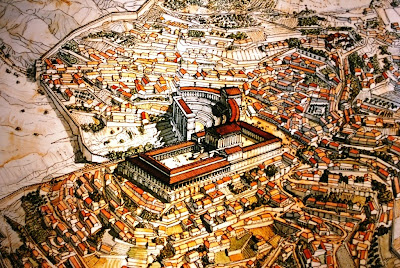
In 2006, I visited Almuñécar, or Sexi Firman Iulium during Roman times. It is famous due to the extended remains of Roman garum containers and a substantial aqueduct. In a small museum various finds are on display, including the above model. At the left side of the town you can see a theater. Unfortunately, I can't find any proper information about the Roman history of Sexi, apart from some details on wikipedia. The town was founded by the Phoenicians. From the 3rd-2nd centuries BC it issued a sizeable corpus of coinage depicting the Phoenician god Melquart on the observe and one or two fish on the reverse, possibly alluding a principle product of the area. The 'Westermann. Grosser Atlas zur Weltgeschichte', equates the Sexi with Almuñécar (38 /II).

Tiberius at Emirita Augusta

Afbeelding
This Saturday, I visited the exhibition 'Konflikt' at Kalkriese and 'Imperium' at the Seestadthalle in Haltern am See (Germany). The exhibitions commemorated the Varus battle, at 9 AD. The Imperium exhibition showed numerous and splendid Roman art of that era. Among these a statue of Emperor Tiberius (42 BC-37AD), once part of the scaenae frons of the theater at Merida, Spain. This statue still has the late republican touch and shows physical strength, energy and charisma. The characteristics are found at the early statues of Octavian. Only after the development of the " Prima Porta " representation of Augustus, a clear division between the princeps and normal people was established. The Roman Imperial cult identified emperors and some members of their families with the divinely sanctioned authority of the Roman State. The framework for Imperial cult was formulated during the early Principate of Augustus, and was rapidly established throughout the Empire and i...

Aulaeum of the theater

Afbeelding
In addition to the permanent decorations, the theater of Caesaraugusta used movable adornments and props for the works being performed. Since the building had no roof from which to suspend part of the stage machinery, it had to be operated from below the stage, taking advantage of the difference in elevation of the stage and the lower orchestra. The largest and most important of these movable decorations was the curtain (aulaeum) which served to conceal the stage from the public. The upper models shows the working quite well. During performances the curtain remained rolled up in al longitudinal channel at the top front of the stage area (pulpitum) and connected to the place from which the stagehands could operate the machinery that raised and lowered it. This machinery consisted of a system of counterweights hanging from masts of up to four meters above the surface of the stage to which the curtain was fastened. In this theater archeologists have located ten curtain wells containi...

Caesaraugusta's theater documented

Afbeelding
The facade framing the front stage was the most attractive architectural feature of the theater, for it was not only the magnificent setting for each performance, but also the place where the citizens paid their respect to the imperial households and its gods. Archeological evidence suggests that the facade was made in straight and curved sections. In it were three valvae or passageways, which gave the actors access from the stage to the postcaenium or backstage area. At the central and lowest part of the building was the orchestra, essential in Greek theaters, but of lesser in Roman theater, since they relied less on the chorus in their plays. At the center of the original orchestra a rectangular pit was discovered, for concealing, possibly the "Caronte Stairs", from which actors could suddenly spring at the stage during performances (like "John Lanting's Theater of the Laugh"). This space was closed early on. One of the exciting finds during the excavation, w...

10,000 spectators in Colonia Clunia Sulpicia

Afbeelding
This morning I visited Clunia, or better Colonia Clunia Sulpicia. The site is attractive because of some nice mosaics. But, happy us, the most significant ruin is the theater. Excavated into rock, it had a capacity of 10,000 spectators; so being one of the largest in Hispania (with a total of about 24 already discovered [Spain + Portugal]). It must have been very steep, because I measured the orchestra. It is only 16 meters wide and only 8 meters in depth. Fascinating in this theater, are the many original seats and the large remains of the scaenea frons. I will soon add more pictures of this great site! More of the history of Clunia is well described here . Noteworthy, is the origin of its name. The city acquired, possibly during the reign of Galba or Hadrian, the status of colonia and the epithet of Sulpicia after Sulpicius Galba, governor of Hispania, proclaimed himself emperor. Galba took refuge in Clunia during the anti-Neronian revolution, 68 AD. At this town he r...

Marcus Valerius Martialis'

Afbeelding
If you see the artist impression of Bilbilis, exposed in the museum of Catalyud, you can imagine that Marcus Valerius Martialis found it difficult to re-adapt to this provincial town, after his great carreer in Rome. A city, with over 800.000 citizens at that time! Nevertheless, I am happy he did so, while it gives me the legitimacy to add some of his great epigrams to this blog. My gifts - Book X, 29 That dish you'd send to me on Saturn's day, you send to your mistress now, Sextilianus: that green outfit you her on Kalends, those called after Mars, that my toga's paid for. Your girls begin to cost you nothing now: Sextilianus, you're fucking with my gifts ! Carpe diem - Book V, 58 Postumus, tomorrow you'll live, tomorrow you say. When is it coming, tell me, that tomorrow? How far off, and where, and how will you find it? In Armenia, or Parthia, is it concealed then? Your tomorrow's as old as Nestor or Priam. How much would it cost you, tel...

Municipium Augusta Bilbilis

Afbeelding
  Originally, Bilbilis was a Celtic-Iberian city inhabited by the ‘Lusones’. It was Romanized during the reign of Augustus and the city became part of the administrative ‘conventus iuriducus Caeseraugusta’. As a fresh municipium – renamed into Augusta Bilbilis - it was transformed significantely; as the city was modified with both a forum and a theater. The theater could contain about 4,500 spectators. The two-stories stage of the theater was decorated by Corinthian columns. Now wrapped up in pur. Whithout being rude, the theater is still a mess. You could reach the cavea by three valvae, or entrances. In contrast to 'common' practice, this Roman construction was build against the slope of the mountain, making use of the natural circumstances. In the museum of the near town Calatayud, beautiful finds are exposed. A selection of the pictures I have made you can find here . Of special interest is one of Bilbilis' famous citizens, Marcus Valerius Martialis . In short epigr...

The circus 2009

Afbeelding
As written in an earlier message, the Tarraco circus was a huge construction. Looking closely, you can find many remains of the Roman city in modern buildings. I was thrilled to find a portico of the circus, conserved in an office of the bank 'La Caixa' at the Placa de la Font. It is great how the remains have been preserved within this modern office.

To the circus of Tarraco!

Afbeelding
This beautiful wooden model, gives an idea of the splendour of the circus of Tarraco during Roman times. It was build during the reign of Domitian (81-96 AD). It was rectangular in shape, some 325 meters long and with a width that varied between a 100 and a 115 meters. It occupied the width of the city (!), from one wall to the other. The circus was the setting for one of the most popular spectacles in ancient times: the chariot race. The splitterwall, or spina , was decorated with commemerative monuments of the city or specific benificiaries. Looking at the picture above, you can hardly imagine that this construction was once a lively scenary of chariot and horse racing. Nevertheless, the city tries to recover some of its ancient past. The blind wall of the 'soon to be demolished' building, visualizes the place where we are in the picture. A clever way of documentary. In his book 'Wagenrennen' or 'Chariot racing', Fik Meijer, professor Ancient History at the...

Surprise party: Colonia Tarraco!

Afbeelding
The theater of Tarraco, or modern Tarragona, is not worth a visit, while the remains are very limited. In 1884 the semicircular seating area was discovered in the garden of the old Capuchin monastery, with thirteen rows of seating almost intact. In 1919 the Institute of Catalan Studies identified the site as of great importance and recovered statues and many architectural elements. The site however, was abandoned afterwards: and pillaged! In 1977, a citizen's movement was able to bring a halt to its destruction. For the theater in my opinion, to late; for Tarrogona a shame. I have taken pictures of the last remains of which even Google does not give any (other) hits. You will get the amphitheater or Merida... These will be presented in next message, with other finds of the theater now at display at the city museum.  Nevertheless, Tarraco has a lot to offer, like the circus and the splendid amphitheater, shown below. It is sensational to dine in restaurants like Pulvinar or Sal...

Visiting Hispania

Afbeelding
Between July 27th and August 9th, I will visit the north eastern part of Spain. Calatayud (Bilbilis), Tarragona (Tarraco) and Clunia (Colonia Clunia Sulpicia) will be among the ancient cities which will be covered in the next episodes of this blog. Hispania, as administratively divided by Augustus, 27 AC. White lines shows the juridical areas, the brown show the provinces. The blue ones are rivers (sic!).

Greek tragedy in Itálica

Afbeelding
In april 2004 I visited Santiponce, a dwelling near Sevilla. Here lies Itálica, founded by Scipio Africanus in 206 BC. It is the first Roman city in Iberica, Spain. The theater dates from the reign of Tiberius, has been rebuilt between 60 and 80 AD, and has been decorated during the reign of Hadrian. Of these last decorations not much is left, but it is well renovated. The cavea is a semi-circle, with a diameter of 77,7 meter. It could hold 3.000 spectators. Here I found a nice hier visualization. Die middag werd de door Aischylos (525-456 v.Chr.) geschreven tragedie 'Agamemnon' opgevoerd. Voordat Agamemnon, heerser over Argos, ten strijde trok tegen Troje, offerde hij zijn dochter Iphigenia om de goden gunstig te stemmen. Bij terugkeer werd hij uit wraak door zijn vrouw en haar liefje vermoord. Er waren bij Agamemnon vooral veel studenten die, veelal met de tekst van Aischylos, de voorstelling volgden. Maar eigenlijk was het daar veel te warm voor. Een handig zon...